Showing posts with label education. Show all posts

Sunday, September 17, 2017

Matholia Squares Problem for Primary 5/6 Students

Tap A takes 3 minutes to fill a container.
Tap B takes 6 minutes to fill the same container.

If both taps are turned on at the same time, how long will it take to fill the container?

Enter your solution below.
Answer correctly and receive 2 weeks free access to Matholia (www.matholia.com)!


Friday, August 25, 2017

Introducing Matholia for the Australian Curriculum

Matholia - The world-class primary mathematics portal from Singapore is being aligned to the Australian Curriculum for the 2018 school year. Contact support@matholia.com to create a free school account today!

 Matholia information pack for Australian Curriculum

For more information visit the Matholia Australian website - www.matholia.com/au

Sunday, October 11, 2015

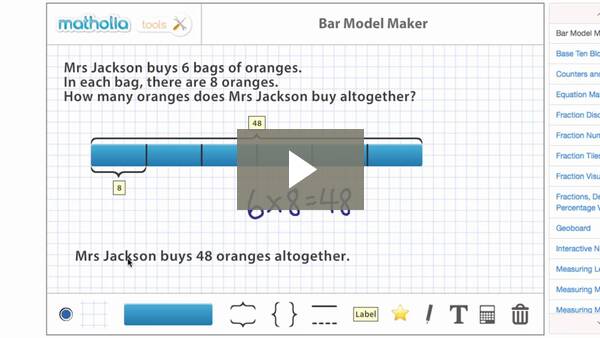
Part-Whole Bar Model – Multiplication

The use of bar models was first implemented into the Singapore maths syllabus approximately 30 years ago as a problem solving tool to assist pupils in visualising word problems. The pedagogy of bar modelling is now an integral part of the teaching and learning of primary mathematics in Singapore.

In this video, we look at how a part-whole bar model can be used to represent a multiplication word problem.


This video is part of the Matholia professional development video series. To see all of the videos in this series, follow this blog, or visit the Video Library on www.matholia.com.

Wednesday, September 16, 2015

Matholia Review and Assessment

The Matholia online portal includes comprehensive review modules ideal for placement tests, continual assessment and end-of-year evaluation.

Key features include:
• pre-test from K to Primary 6.
• review modules that follow the spiral approach of the Singapore syllabus.
• pre-test, term, mid-year, full-year and topical reviews
• teacher-assigned reviews.
• instant scores and progress tracking.
• suitable for classroom assessment of competencies across the syllabus.
• allows pupils to gain confidence by re-testing at any time.


Review modules can be accessed on the Matholia website or via the ‘Matholia Essentials’ apps. All reviews on mobile devices are logged to the students’ main Matholia account.

Exploratory Maths Tools and Virtual Manipulatives

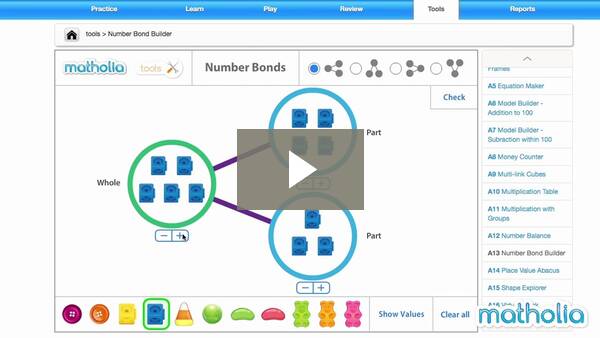
Matholia Tools consists of a comprehensive library of virtual manipulatives that are ideal for engaging teaching in the classroom or encouraging exploratory learning at home.


Used in combination with the resources and videos in the Matholia learn environment, the tools can also facilitate autonomous learning in a flipped classroom situation.

Matholia Tools can be accessed with any active membership. An app containing all tools is also available for free download on the iTunes app store and Google Play.

Used in combination with the resources and videos in the Matholia learn environment, the tools can also facilitate autonomous learning in a flipped classroom situation.

Matholia Tools can be accessed with any active membership. An app containing all tools is also available for free download on the iTunes app store and Google Play.


Matholia is Singapore's most comprehensive primary mathematics portal. Create a free trial account on Matholia now, or email support for more information.

Tuesday, September 15, 2015

Endless, Dynamic Fun Practice

The Matholia portal brings together a diverse range of learning resources based on the pedagogical principles of the Singapore MOE syllabus. A core component of Matholia is the practice environment, consisting of over 1600 dynamic practice modules from K to Primary 6.

Dynamic Practice
Each Matholia practice module uses dynamic question generation with extensive variables and question types. This minimises question repetition and ensures students have a solid understanding of the mathematical concept they are practising on completion of the module. Like many of Matholia’s resources, practice modules are sequenced to follow the Concrete-Pictorial-Abstract (CPA) approach.


Instant feedback and rewards allow students to self-assess their knowledge and skills as they progress through the curriculum. All progress and achievements are recorded in the Matholia progress tracking and reporting environment.


Create a free trial account now at www.matholia.com or email school inquiries to the Matholia support team.

What is Matholia?

Matholia is Singapore’s most comprehensive online primary maths portal.
The portal provides students, teachers and parents with dedicated content based on the underlying principles of the Singapore Ministry of Education’s mathematical framework. Matholia’s diverse resources are developed in close consultation with teachers, experienced MOE-approved authors and higher-education researchers. Key components on the Matholia portal include:

• dynamic practice across the entire primary mathematics syllabus.
• comprehensive collection of instructional videos and learning sheets.
• pre-test, term, mid-year, full-year and topical reviews.
• progress tracking and reporting for parents and teachers.
• maths tools and virtual manipulatives.
• full range of mobile apps for iPad and Android devices.
• digital textbooks.
• printable resources.
• speed skills mental maths activities for years 1 to 3.


Matholia is a true cross-platform resource. It can be accessed on all operating systems and web browsers. Free apps are also available for use on iPad and Android tablet devices. To ensure Internet safety, all of Matholia’s video content is hosted on Wistia.


For more information on Matholia school adoptions, visit www.mathoila.com or contact support@bre.com.sg.

Why Singapore Mathematics?

Singapore's Achievement in Primary Maths

For over two decades, comparative studies on mathematics achievement have consistently ranked Singapore’s primary students as one of the top achievers. In the most comprehensive study, the Trends in International Mathematics and Science Study (TIMSS), Singapore consistently ranks in the top position internationally.

Source: Trends in International Mathematics and Science Study (TIMSS)

The Singapore MOE Mathematics Syllabus

Singapore’s consistently high achievement in mathematics is attributed to its research-based pedagogy and the underlying principles of the Singapore primary mathematics syllabus that is infused into all Ministry of Education approved resources.

The syllabus sees problem solving as central to the learning of mathematics. It emphasises the importance of conceptual understanding, skill proficiency and the development of thinking skills in building problem-solving ability. The importance of differentiated instruction and the integration of technology in learning and assessment is also emphasised.

Through its comprehensive Matholia learning portal, Blue Ring Education is dedicated to delivering innovative Singapore mathematics resources to schools internationally.


For more information on Matholia school adoptions, visit www.mathoila.com or contact support@bre.com.sg.

Saturday, September 12, 2015

Singapore Math Classroom Diary

Singapore Math Classroom Diary

Year level: Grade 3 
Topic: Fractions 1

Today, I began teaching the grade 3 fractions unit to a group of students who require more support than the average third grader at my school. I wanted to document the sequence of lessons I taught, in part to think about how I use technology to teach the concepts in the unit.

With the faculty here, as well as in my training seminars, I try to emphasize to teachers that they need to begin their lesson planning with a foundational question: what is the most important mathematics that I need to teach today? Looking through the material I have planned, I interpret the answer to that question to be: Fractions show us parts of a whole. The parts come together to make a whole. This is what I want my students to understand and apply by the end of my 60-minute lesson.

In the textbook, this idea is taught by showing shaded and unshaded parts of fraction diagrams, using multiple representations such as fruit, circles, rectangles, triangles and other polygons. I use a 5-component lesson plan for my math classes, so I will present the lesson through the sum of its components. You can see how I used technology to help me teach concepts and skills throughout the lesson.

Mental Math
Today was the first math class after vacation. I wanted to begin reviewing multiplication and division fact practice right away to clear out any vacation cobwebs. Each student completed a 5-10 minute session with the ipad app connected an adaptive, web-based math facts practice solution that our school has been piloting this year. I am pleased with the independent and differentiated work that went on during this component of the lesson. Each child was practicing facts at their level. I was able to carefully observe one particular child who has not been making much progress. I noted that his attention wandered, and at the same time, he rushed in entering answers he knew. How can I have this child work at a more even pace. perhaps coupling that even pace with saying facts out loud?

Problem Solving
With this group, I have been remiss in keeping up with measurement skills. All this week, I have planned to use problem solving to work with telling time on an analog clock. Today, I presented a clock on my smartboard. I had each child write down the time shown (we practiced time to the nearest 5 minute) and then write down what time it would be 20 minutes later. 3 clocks were presented, one per screen. I could see children make progress with each example, and the group was independent with the task by the final example. The large and moveable clock I had designed on the smartboard was a clear and easy-to-use visual. I realize now that I could have used Matholia’s Virtual Clock Tool with even greater effect. I would be testing out a different Matholia tool later in the lesson, so this would have made more sense. Ahh, 20/20 hindsight. 

Directed Lesson
I began the directed lesson with the fruit examples right out of the textbook. We looked at fruits that had been cut up into equal parts. I emphasized how, in the example of fruit cut into fifths, the two fifths on one plate could be combined with the 3 fifths on the second plate to make 5 fifths of the fruit, which was the same as the whole fruit. This part/part/whole concept was certainly not new to these students, as we have been using this kind of language and representation with them throughout their math learning here. I made a big deal about how these pieces were cut into five equal parts, not just five parts. Fifths means five equal parts. If the parts aren’t equal, we cannot say that it has been cut into fifths.

I then digressed from the textbook and projected several circle models for fractions. I had students write down the fraction that was shaded and the fraction that was not shaded. I pointed out how the two parts (shaded and unshaded) came together to make one whole. Without really thinking about it ahead of time, I pushed the idea further into abstraction as I wrote fraction addition sentences that described each circle representation, adding the fraction shaded to the fraction unshaded and totalling to one whole. I knew that this was pushing the level of abstraction, for this group, but instinctively, I felt it was important for the kids to see the abstraction of the fraction equation right alongside the pictorial representation of the fractions.

Activity
The directed lesson then evolved into a partner activity, moving along with the text, I represented fractions with bar models. We worked through several examples on the Smartboard, with me releasing more and more responsibility to the students in the class to look at the fraction diagram, then point out the fraction shaded, the fraction unshaded, and the corresponding fraction equation.

Independent Practice
The corresponding workbook page helped the students practice the ideas that we discussed and that they had worked on with their partners. It took the group about 15 minutes to complete and partner-check the three assigned exercises.
For the last 5 minutes of class, I brought up Matholia’s Fraction Disc Tool. There, I pulled up the disc for one whole, and then pulled several unit fractions onto the screen. We were all able to see how ⅓ is actually a large piece, while ⅕ or 1/9 are actually very small pieces. The visuals helped to build foundational knowledge (without a lot of words from me) of the meaning of the denominator. On a whim, I used the rotate feature on the 1/12 piece to show how many 1/12 pieces would fit into ¼. This was a bit clunky. I didn’t want to spend a lot of time fiddling with the visual right in front of the class. Perhaps next time I will prepare a few tabs on my browser before class, that way I could quickly shift between set representations without building diagrams on the fly.

So, there it is. The lesson was a success. After having written it up, I can see how I used technology much more than I realized. Writing also gave me more ideas about how to incorporate the powerful tools in matholia and blend them with the Smartboard presentations I have already built for the lessons.

by Dr Kevin Mahoney
Dr. Kevin Mahoney is an academic researcher and Math Curriculum Coordinator for an independent school outside of Boston, MA. With over 20 years of elementary teaching experience Dr. Mahoney also works as a consultant and trainer to schools and teachers implementing Singapore Math Curricula. Read more about Dr. Mahoney at singaporemathmentor.com.
Follow the matholia blog for more classroom diaries and the latest Singapore math news.
If you have a Singapore math story, experience or teaching tip, we'd love to hear from you. Contact matt@bre.com.sg for more information on how you can contribute.

Thursday, April 23, 2015

Virtual Manipulatives and Tools

Virtual Tools in the Elementary Classroom

When I think about it, words can sometimes get in the way of my math teaching. There are moments in my elementary math classes where I am striving mightily to put something into words that would be so much better understood without words. I wish, sometimes too late, that I had prepared a physical object, a picture, or a moving picture to show students what is happening when, say, one is regrouping in addition. There have been plenty of these moments in my teaching, where in the back of my mind I am wishing I had prepared a visual instead of trying so hard to put a math concept or process into words. I can picture myself, like a native speaker trying to explain driving directions to a tourist who doesn’t speak English.

Computer technology is helping me with this challenge in teaching elementary math. Over the years, I have become more and more dependent on visual representations developed by others that I can show to my students instead of telling them about it. One of my all-time favorites is this simple animation used to help children understand the relationships between circumference, diameter and pi:

            
Perhaps you will see what I mean when I talk about how this picture is worth a thousand math teacher words.

Of course, planning hands-on experiences with manipulative materials is a foundation of elementary math teaching around the world and is often the best way to get away from words. When I do not have a physical object for children to explore, or when circumstances in the classroom do not allow for the time necessary for managing the stuff for each student, it is this growing trove of helpful visuals that is becoming a well-worn tool of my math teaching toolbox.

For years I have relied on the simple but effective visual teaching tools provided in the National Library of Virtual Manipulatives (NLVM). The tools are also collected for easy access so I do not have to spend a lot of time searching the internet for the right demonstration. Consider the “fractions - adding” activity as an example of the power of these tools.

Matholia (www.matholia.com.sg) also offers an updated collection of virtual tools for active demonstration to students. I’ll give you an example of how I used the collection. I was doing some remediation work with a second grader who was using the standard algorithm for addition relatively well, but his errors showed that he only understood the procedure, but had weak understanding of the meaning behind the procedure. I pulled up Matholia’s place value tool, and we added numbers together, watching what happened on the screen, and connecting the action to what was happening in his pencil-paper work. I was proud that I could restrain myself from too many words as I had him articulate for himself the process of regrouping on the screen, and then the representation of regrouping on his paper.


I know that I am relying on these virtual tools more and more. Because they are so powerful, I want to access them easily and quickly. I want the whole toolbox in one place so that when I find myself in that moment when words are actually getting in the way, the visual representations are nearby and easy to use. I don’t think we are there quite yet, but we are close. I wonder, would every elementary math teacher’s toolbox be the same? Would one size fit all?

Matholia's growing library of over 100 virtual tools and manipulatives is included in all Matholia subscriptions. If you are already an adopting school and would like an offline version for the tools kit, contact support@bre.com and reference this blog.

by Dr Kevin Mahoney
Dr. Kevin Mahoney is an academic researcher and Math Curriculum Coordinator for an independent school outside of Boston, MA. With over 20 years of elementary teaching experience Dr. Mahoney also works as a consultant and trainer to schools and teachers implementing Singapore Math Curricula.

Thursday, April 9, 2015

Bar Models

From the common core standards for mathematical practice:
They (mathematically proficient students) are able to identify important quantities in a practical situation and map their relationships using such tools as diagrams, two-way tables, graphs, flowcharts and formulas. They can analyze those relationships mathematically to draw conclusions. They routinely interpret their mathematical results in the context of the situation and reflect on whether the results make sense, possibly improving the model if it has not served its purpose.

What is the point of bar models?

The Singaporean teaching strategy of bar modelling has spread worldwide. What I want to address here is the common misconception I run into with teachers across the United States: the idea that bar models are just for problem solving.

Now, don’t get me wrong, Singapore’s Model Method is a very effective problem solving strategy. My own academic research attests to that fact. But bar models can help teachers meet many of their other goals essential for good elementary math teaching.

Bar Models are useful for teaching concepts

I use bar models to help children understand addition, subtraction, multiplication, division, fractions, ratio and percentage. This simple representation, used in conjunction with others, provides a flexible and clear model of all of these mathematical relationships. I don’t need to present a bar model as part of a word problem in order to use it to show students instead of telling them.


Bar Models are good for developing reasoning and communication

When a child draws a model of a word problem, she provides evidence of her thinking without words. Bar models can take the place of paragraphs of writing required when a student must explain how they arrived at a solution. I have found over and over again that when a child and I can point to and touch a model that they have drawn, we are able to communicate with each other more efficiently and precisely. 

Bar Models develop algebraic reasoning

Bar Models were designed, in part, as aids to algebraic reasoning. When the child can see from her bar model that 3 boxes hold 45, she can see that division can be used to determine that one box holds 15. Once the value of one box is discovered, she can use that information to determine several different relationships, differences and totals. This is concrete algebraic reasoning presented at an early age to elementary children. For the students we work with at our school, such reasoning will be natural to them by the time they leave us for middle school.

So consider the lowly bar model. It may be more powerful and useful than you once thought.


Note:  Bar models are used throughout the Matholia practice modules, instructional videos and e-books. Bar model tools can also be found in the Matholia Tools environment.

by Dr Kevin Mahoney
Dr. Kevin Mahoney is an academic researcher and Math Curriculum Coordinator for an independent school outside of Boston, MA. With over 20 years of elementary teaching experience Dr. Mahoney also works as a consultant and trainer to schools and teachers implementing Singapore Math Curricula.