From the common core standards for mathematical practice:
They (mathematically proficient students) are able to identify important quantities in a practical situation and map their relationships using such tools as diagrams, two-way tables, graphs, flowcharts and formulas. They can analyze those relationships mathematically to draw conclusions. They routinely interpret their mathematical results in the context of the situation and reflect on whether the results make sense, possibly improving the model if it has not served its purpose.
What is the point of bar models?
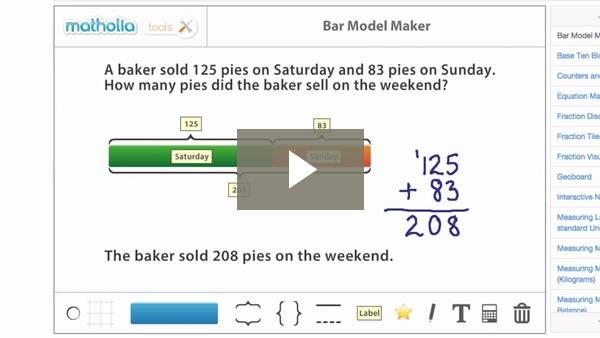
The Singaporean teaching strategy of bar modelling has spread worldwide. What I want to address here is the common misconception I run into with teachers across the United States: the idea that bar models are just for problem solving.
Now, don’t get me wrong, Singapore’s Model Method is a very effective problem solving strategy. My own academic research attests to that fact. But bar models can help teachers meet many of their other goals essential for good elementary math teaching.
Bar Models are useful for teaching concepts
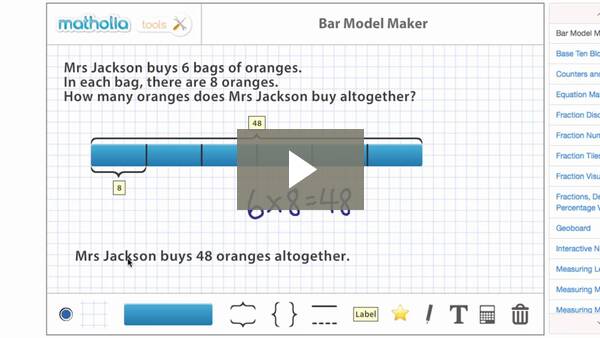
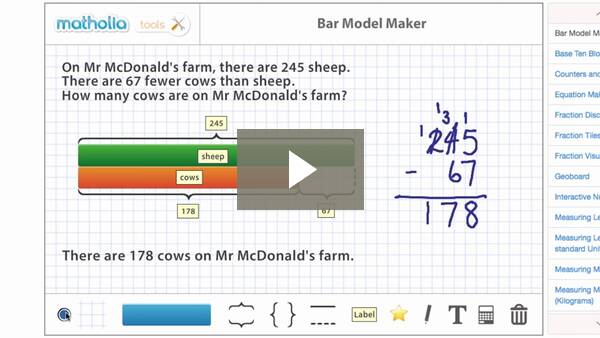
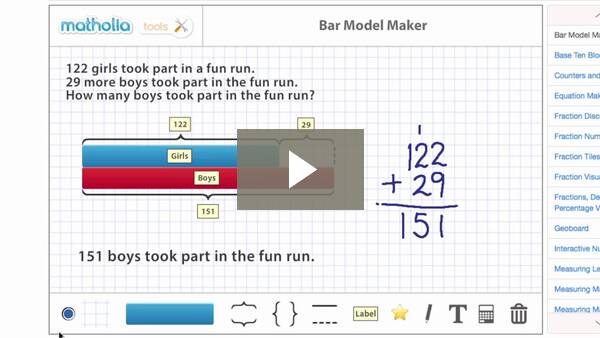
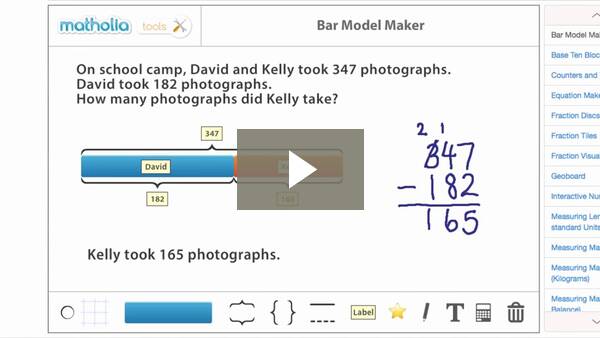
I use bar models to help children understand addition, subtraction, multiplication, division, fractions, ratio and percentage. This simple representation, used in conjunction with others, provides a flexible and clear model of all of these mathematical relationships. I don’t need to present a bar model as part of a word problem in order to use it to show students instead of telling them.
Bar Models are good for developing reasoning and communication
When a child draws a model of a word problem, she provides evidence of her thinking without words. Bar models can take the place of paragraphs of writing required when a student must explain how they arrived at a solution. I have found over and over again that when a child and I can point to and touch a model that they have drawn, we are able to communicate with each other more efficiently and precisely.
Bar Models develop algebraic reasoning
Bar Models were designed, in part, as aids to algebraic reasoning. When the child can see from her bar model that 3 boxes hold 45, she can see that division can be used to determine that one box holds 15. Once the value of one box is discovered, she can use that information to determine several different relationships, differences and totals. This is concrete algebraic reasoning presented at an early age to elementary children. For the students we work with at our school, such reasoning will be natural to them by the time they leave us for middle school.
So consider the lowly bar model. It may be more powerful and useful than you once thought.
Note: Bar models are used throughout the Matholia practice modules, instructional videos and e-books. Bar model tools can also be found in the Matholia Tools environment.
Dr. Kevin Mahoney is an academic researcher and Math Curriculum Coordinator for an independent school outside of Boston, MA. With over 20 years of elementary teaching experience Dr. Mahoney also works as a consultant and trainer to schools and teachers implementing Singapore Math Curricula.